Vol. 25, No. 1 (2026), Proc26750 https://doi.org/10.24275/rmiq/Proc26750


Dehydration of light crude oil using a semi-organic demulsifier derived from the aqueous extract of Mangifera indica L.


Authors

F. de J. Solana-Neri, L.M. Pérez-Gutiérrez, A.G. Vital-Ocampo, D. de J. Montoya-Hernández, M. del C. Milán-Cárdenas


Abstract

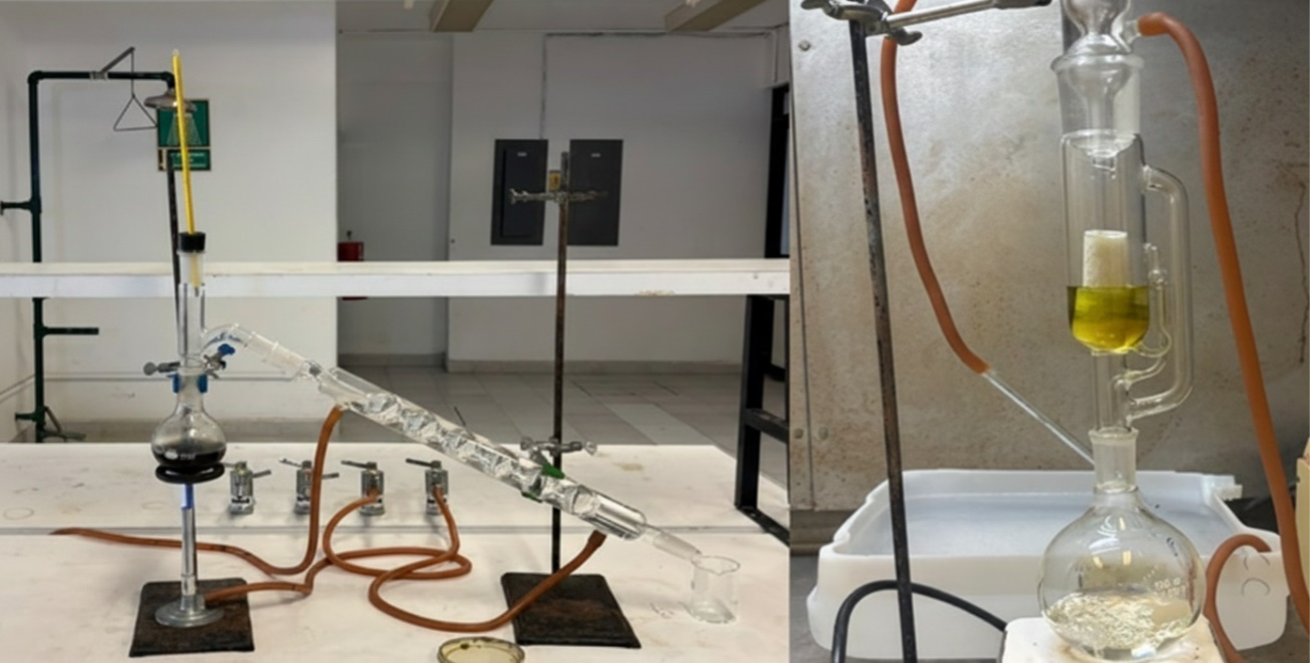
The presence of water in water-in-oil emulsions is a significant operational problem in the oil industry due to its impact on corrosion, scale formation, and increased costs during crude oil transportation and processing. This study evaluates the efficiency of a semi-organic demulsifier obtained from Mangifera indica L. leaf extract for the dehydration of light crude oil as a sustainable alternative to conventional synthetic agents. The aqueous extract was obtained using maceration and Soxhlet methods and evaluated in synthetic W/O emulsions (80:20 v/v) prepared with a light crude oil of 32.87 °API from the Campeche Sound. Dehydration tests were performed in accordance with ASTM D-4007 at a temperature of 60 °C, using different concentrations of the demulsifier (500, 1000, and 2000 μL). Additionally, the crude oil was characterized before and after treatment by determining its density, API gravity, and SARA analysis. The experimental results showed that the semi-organic demulsifier was most efficient at a concentration of 1000 μL, achieving a higher water recovery than that obtained with a commercial demulsifier under the same operating conditions. At higher concentrations, a decrease in efficiency was observed, attributed to interfacial supersaturation phenomena that favor emulsion stabilization. The results indicate that Mangifera indica L. leaf extract does not significantly alter the physicochemical properties of crude oil and performs competitively, positioning itself as a viable alternative with low environmental impact and potential for industrial application in light crude oil dehydration processes.


Keywords

Demulsification; crude oil dehydration; Mangifera indica L.; W/O emulsions.


References

  • Alaiya, M. A., & Odeniyi, M. A. (2023). Utilisation of Mangifera indica plant extracts and parts in antimicrobial formulations and as a pharmaceutical excipient: a review. Future Journal of Pharmaceutical Sciences, 9, 29. https://doi.org/10.1186/s43094-023-00479-z.
  • ASTM D-287-2000. Standard Test Method for API Gravity of Crude Petroleum and Petroleum Products (Hydrometer/Method).


  • ASTM D-2007-2019.  Standard Test Method for Characteristic Groups in Rubber Extender and Processing Oils and Other Petroleum-Derived Oils by the Clay-Gel Absorption Chromatographic Method.
  • ASTM D 3279–1997 Standard Test Method for n -Heptane Insolubles.


  • ASTM D-4007-2022 Standard Test Method for Water and Sediment in Crude Oil by the Centrifuge Method (Laboratory Procedure)
  • Bila, A., & Torsaeter, O. (2021). Experimental Investigation of Polymer-Coated Silica Nanoparticles for EOR under Harsh Reservoir Conditions of High Temperature and Salinity. Nanomaterials, 11, 765. doi:https://doi.org/10.3390/nano11030765.


  • Birbal C.V., Martínez S. & Castro Y.  (2025). Enhancing heavy crude oil recovery: injection of FeNi nanoparticles with steam into porous medium. Revista Mexicana de Ingeniería Química. Vol. (24)1, 1-12. https://doi.org/10.24275/rmiq/Proc24389
  • Buelvas-Puello, L. M., Franco-Arnedo, G., Martínez-Correa, H. A., Ballesteros-Vivas, D., Sánchez-Camargo, A. d. P., Miranda-Lasprilla, D., Narváez-Cuenca, C.-E., & Parada-Alfonso, F. (2021). Supercritical fluid extraction of phenolic compounds from mango (Mangifera indica L.) seed kernels and their application as an antioxidant in an edible oil. Molecules, 26(24), 7516. https://doi.org/10.3390/molecules26247516


  • Chuiza Rojas, M. R., Rivera, Y., Ramírez, J., & Garmendia, H. (2018). Experimental study of the dehydration of a medium crude oil using extracts from blackberry leaves and pine bark. Science and Engineering, 39(3), 279-286. Redalyc.org.
  • https://www.redalyc.org/articulo.oa?id=507557607008

Faizullayev S., Adilbekova A., Kujawski W. , &  Mirzaeian M. (2022).Recent demulsification methods of crude oil emulsions – Brief review. Journal of Petroleum Science and Engineering. Volume 215, Part B. https://doi.org/10.1016/j.petrol.2022.110643.


  • Hani Maddah Z. & Mohammed Naife T. (2019). Demulsification of Water in Iraqi Crude Oil Emulsion. Journal of Engineering Chemical, Petroleum and Environmental Engineering. (11) Volume 25. https://doi.org/10.31026/j.eng.2019.11.03
  • Işık, M., Dikici, E., Altın, S., Alp, C., & Beydemir, Ş. (2025). Phenolic content, antioxidant capacity, and therapeutic potential of mango (Mangifera indica L.) leaves. Food Science & Nutrition, 13(5), e70263. https://doi.org/10.1002/fsn3.70263


  • Mananquil, T. (2024). Electrospinning Asphaltenes with Low-Cost Polymers: Towards High-Value Carbon Materials. (V1). Toronto Metropolitan University https://doi.org/10.32920/26052775
  • Mehmood, H., Mehmood, J., & Zulfiqar, N. (2024). Exploring the phytochemistry and pharmacology of Mangifera indica L. leaves: A review. International Journal of Plant-Based Pharmaceuticals, 4(1), 9–18. DOI: 10.29228/ijpbp.38


  • Pal, B., Kumar, R., & Naiya, T. K. (2021). Demulsification of crude oil-water emulsion using naturally formulated demulsifier. Petroleum Science and Technology39(21–22), 1027–1042. https://doi.org/10.1080/10916466.2021.1983599.
  • Parlov Vuković, J., Novak, P., & Jednačak, T. (2019). NMR Spectroscopy as a Tool for Studying Asphaltene Composition. Croatica Chemica Acta, 92(3), 323–329. https://doi.org/10.5562/CCA3543.


  • Quiroz-Reyes, C.N., Aguilar-Méndez, M.A.; Ramírez  y  Ronquillo-De Jesús, E. (2013). Comparative study of ultrasound and maceration techniques for the extraction of polyphenols from cocoa beans (Theobroma cacao L.). Rev. Mex. Ing. Quím., vol.12, n.1, pp.11-18. ISSN 1665-2738.
  • Rezaei, A., Abdollahi, H., Derikvand, Z., Hemmati-Sarapardeh, A., Mosavi, A., & Nabipour, N. (2020). Insights into the Effects of Pore Size Distribution on the Flowing Behavior of Carbonate Rocks: Linking a Nano-Based Enhanced Oil Recovery Method to Rock Typing. Nanomaterials, 10(5), 972. https://doi.org/10.3390/nano10050972


  • Smith, J., & Jones, L. (2022). Demulsifiers in the oil industry: challenges and trends. Journal of Petroleum Processing, 18(3), 145–159.
  • Tixi, H., Barahona, N., & Garmendia, H. (2021). Evaluation of ethanolic extracts of mulberry and mango leaves in the dehydration process of heavy crude oils. Perfiles, 1(26), 13-20. https://doi.org/10.47187/perf.v1i26.131


Ye, F., Mi Y. , Liu H., Zeng G., Shen L., Feng X., Yang Y., Zhang Z., Yuan H.,  & Yan X. (2021). Demulsification of water-in-crude oil emulsion using natural lotus leaf treated via a simple hydrothermal process. FUEL. Volume 295.

https://doi.org/10.1016/j.fuel.2021.120596.