
Vol. 25, No. 3 (2026), Mat26861 https://doi.org/10.24275/rmiq/Mat26861
|
Experimental evaluation of detrending and spectral/time-frequency methods for electrochemical noise-based corrosion rate estimation of aluminum 6061-T6 in sulfuric acid |
|
|
AuthorsO.J. Ramos-Negrón, J.F. Solís-Alvarado, J. Uruchurtu-Chavarin, L. Morales-Clemente, C. Reyes-del-Valle Abstract
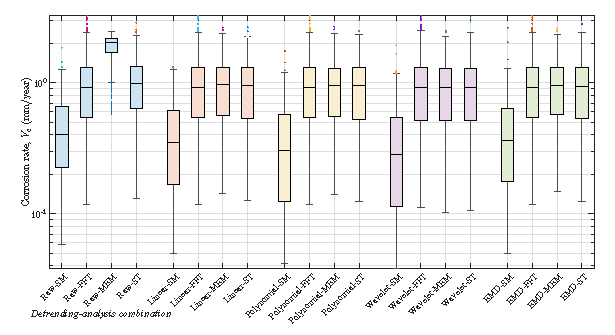
This work presents an experimental evaluation of detrending techniques and spectral analysis methods for estimating the corrosion rate (Vc) of aluminum 6061-T6 exposed to a \SI{15}{\percent} w/w sulfuric acid solution. A total of \num{1024} electrochemical current noise (ECN) and electrochemical potential noise (EPN) records were analyzed under passive monitoring conditions. The signals were processed using a factorial combination of five preprocessing conditions: raw signal, linear detrending, polynomial detrending, wavelet detrending, and empirical mode decomposition (EMD), together with four analysis methods: statistical method (SM), fast Fourier transform (FFT), maximum entropy method (MEM), and Stockwell transform (ST). The estimates were compared with reference values obtained from Tafel polarization curves and a commercial Gamry system. The results showed that, when all preprocessing conditions were considered, ST provided the lowest global relative error, followed by FFT, whereas MEM was strongly affected by the Raw--MEM condition. When the Raw condition was excluded and only detrended signals were analyzed, ST and MEM showed the closest agreement with the Gamry reference value, with average relative errors of \SI{10.8}{\percent} and \SI{11.8}{\percent}, respectively. The statistical method systematically underestimated $V_c$. Two-way ANOVA confirmed significant effects of detrending, analysis method, and their interaction (p < 10-300). These findings demonstrate that the combined selection of preprocessing and spectral/time-frequency analysis is critical for obtaining reliable corrosion-rate estimates from electrochemical noise data, particularly in systems affected by drift, transient behavior, or passivation.
KeywordsElectrochemical noise, Corrosion monitoring, Detrending techniques, Time-frequency analysis (FFT, MEM, ST), ANOVA. |
|